TPATemporal Prototype Alignment
NeurIPS 2026 Poster 22180

Temporal Prototype Alignment

for Frozen-Feature Dataset Distillation

Rui Ding1, Jing Hu1, Mei Chen1, Xi Wu1, Hualin Zhou3, Fan Wu2, Kehua Guo2*, Tao Gu4

1 Chengdu University of Information Technology2 Central South University3 Macquarie University4 Shanghai Jiao Tong University

* Corresponding author: Kehua Guo.

Reuse gradient evidence across time.
Distill images that transfer across encoders.

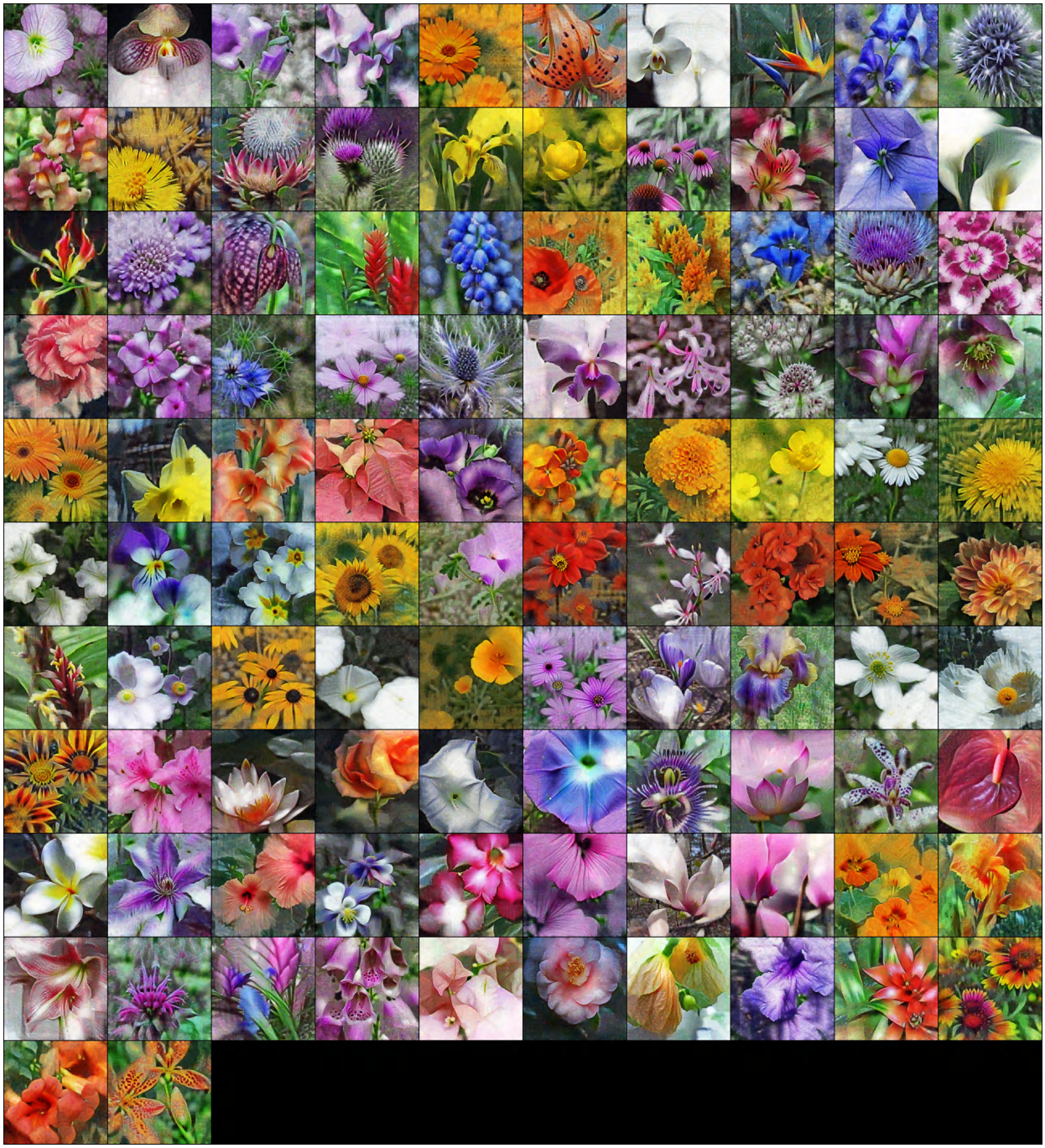
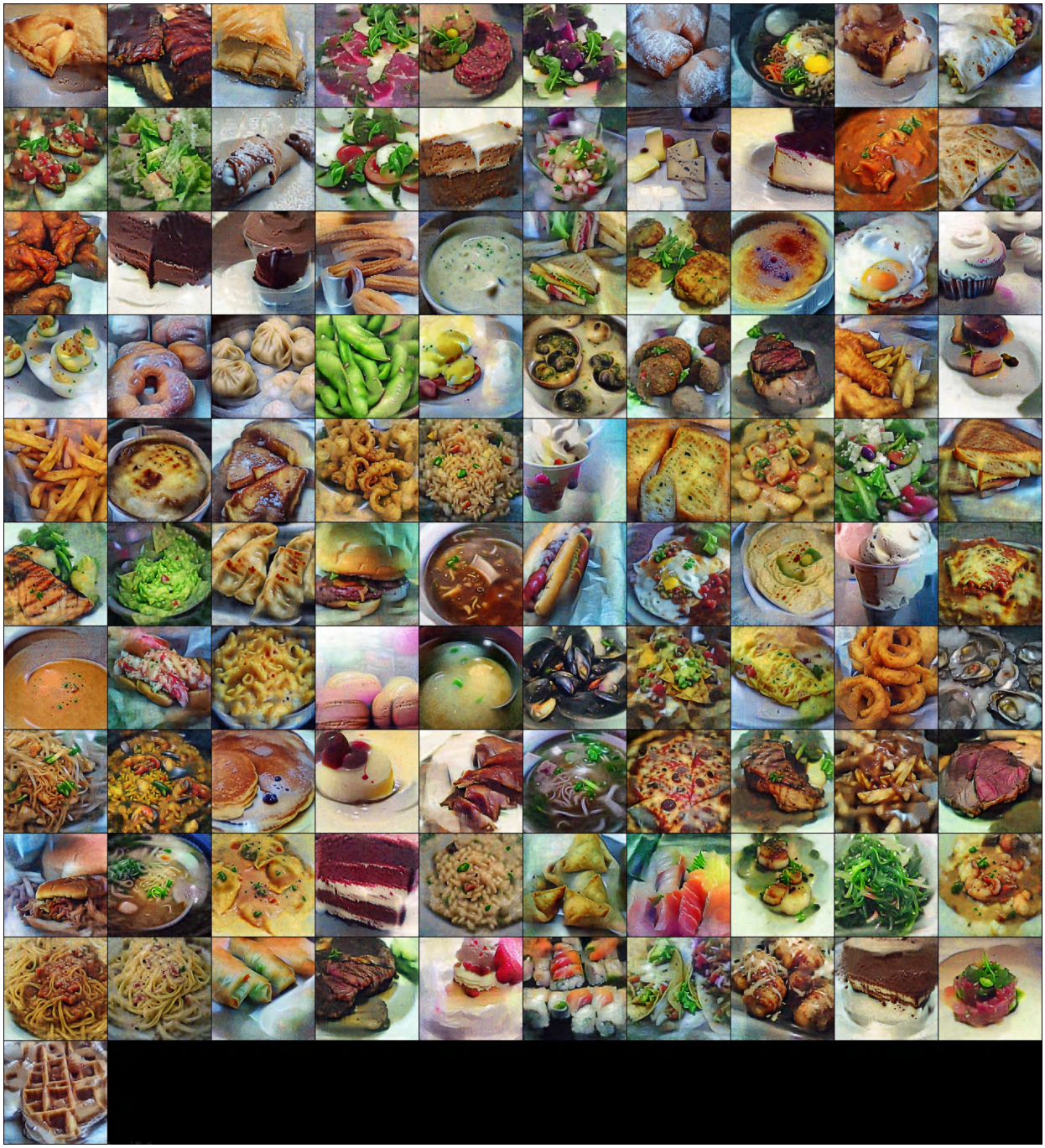
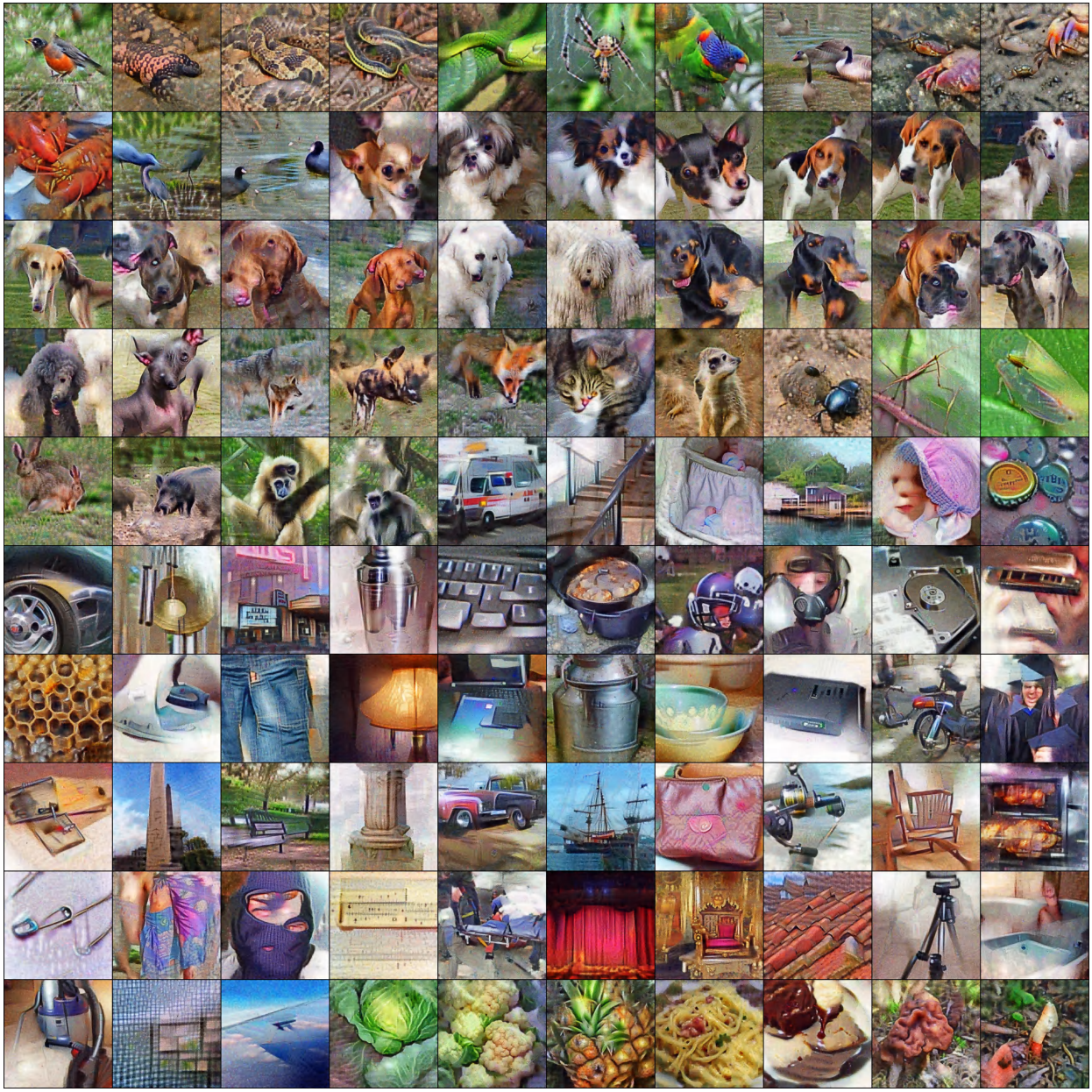
Selected rows of synthetic ImageNet-100 images distilled with CLIP, DINOv2 and MoCo-v3.
A dataset in 100 images. Selected rows from our ImageNet-100 set, distilled at one image per class with three frozen teachers. Explore the complete sets →
The idea

A small image set.
A richer learning signal.

Dataset distillation compresses a large training set into a small synthetic set. With frozen vision encoders, the challenge is to preserve useful class information while keeping synthesis affordable—and to transfer that information to models beyond those used for synthesis.

TPA changes where the evidence comes from. Rather than constructing a gradient target from many simultaneous augmented views, it accumulates real-gradient statistics over optimization steps. Synthetic images then match the resulting class prototypes through a contrastive objective within each teacher.

This couples temporal reuse with multi-teacher class alignment: a compact history supplies the target, and several frozen teachers shape one shared set of pixels.

01 / Two complementary innovations

From simultaneous views
to accumulated evidence

Use time to stabilize the target. Use class relationships to combine teachers.

01

Reuse evidence over time

Spatial multi-view matching

Many views at one step
Concurrent computation

TPA · temporal prototype

One fresh view at each step
Persistent moment buffers

Adaptive Temporal Momentum (ATM) retains useful history in a class-wise gradient prototype. It replaces repeated concurrent views with statistics accumulated during synthesis.
02

Align classes within each teacher

CLIPLocal class lossDINOv2Local class lossMoCo-v3Local class loss
One shared synthetic image set

Contrastive Consensus Alignment (CCA) matches same-class gradient pairs and separates different classes. Each teacher works in its own feature space; their losses jointly update the synthetic pixels.

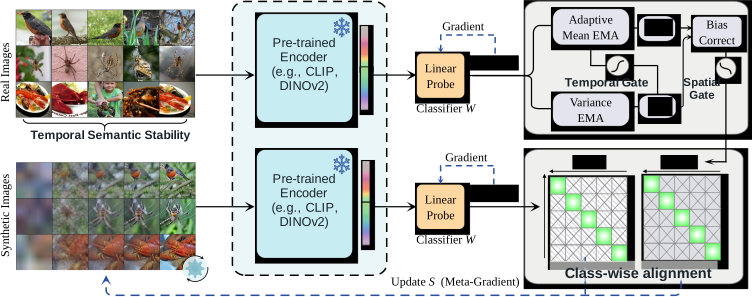
THE COMPLETE FRAMEWORKOpen full-size figure ↗
Original TPA method figure: real gradient accumulation, temporal prototypes, synthetic gradients and contrastive consensus alignment.
Read from real evidence to synthetic images. Frozen encoders provide features; a fresh classifier head at each step defines real and synthetic gradients. ATM builds the real-data target, and CCA supplies the learning signal for the synthetic pixels.
1

Collect comparable gradients

At each step, real and synthetic images use the same freshly initialized classifier head on top of a frozen encoder. Class-wise classifier gradients provide the representation to match.

2

Build a temporal prototype

ATM gates the first-moment update using gradient reliability and tracks a fixed-decay second moment. Inverse-RMS weighting forms the prototype; initialization-mass correction accounts for zero-initialized moments.

3

Optimize through class alignment

Within each teacher, synthetic class gradients are compared with real class prototypes. Same-class pairs are positives; other classes are negatives. Summed teacher-local losses update a common image set.

Why independent teacher spaces work: each teacher produces class-to-class alignment scores in its own feature coordinates. Combining the losses does not require equal feature dimensions or direct alignment between teacher embeddings.

02 / Generalization

One distilled set.
Nine unseen evaluation encoders.

ImageNet-100 · one image per class · frozen-feature evaluation

+3.3pp

Linear probing

89.0% → 92.3%

+7.7pp

1-shot inference

80.7% → 88.4%

Reported mean gains of TPA-CDM over LGM-D across nine evaluation encoders.

TPA-D isolates the single DINOv2 teacher setting. TPA-CDM combines CLIP, DINOv2 and MoCo-v3 during synthesis.

Explore transfer by encoder

Linear probing trains a classifier on frozen features of the distilled set.

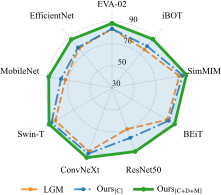
Paper radar plot of linear-probing accuracy across nine encoders.
Original paper plot, including additional distilled-set variants.
Linear-probing accuracy (%) · ImageNet-100, IPC = 1
Evaluation encoderLGM-DTPA-DTPA-CDM
EVA-0285.286.688.6
iBOT83.484.487.7
SimMIM94.596.498.6
BEiT94.995.095.6
ResNet-5088.786.991.4
ConvNeXt94.296.497.3
Swin-T94.894.696.0
MobileNetV380.279.688.3
EfficientNet85.183.987.4
Reported mean89.089.392.3

What to notice. TPA-D gives a modest average gain over LGM-D; combining three teachers produces the larger transfer improvement. The single-teacher gains are not uniform across encoders.

D = DINOv2; CDM = CLIP + DINOv2 + MoCo-v3. Values and reported means are transcribed from the manuscript; rounding of per-encoder entries can differ from the reported mean.

03 / Synthesis efficiency

Temporal reuse reduces
the working footprint.

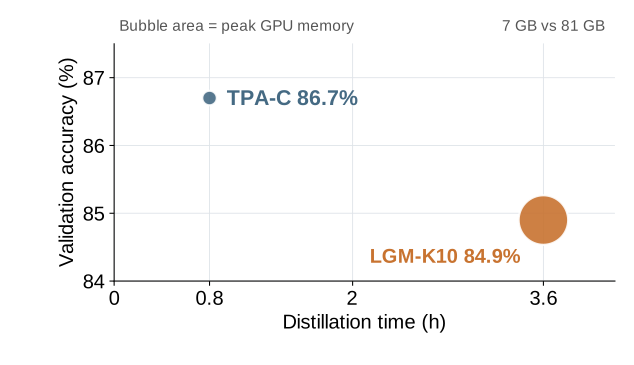
For CLIP on ImageNet-100 at one image per class, TPA reduces peak GPU memory by approximately 91% and finishes synthesis sooner, while improving accuracy.

Peak memory
81 GB → 7 GB
Synthesis time
3.6 h → 0.8 h
Accuracy
84.9% → 86.7%

Measured hardware: LGM uses 4 × RTX 4090. TPA uses 1 × RTX 4090.

CLIP comparison of synthesis memory, time and accuracy for LGM and TPA.
Efficiency comparison using the paper’s reported CLIP measurements. Bubble area shows peak GPU memory. Click to inspect the full-size figure.
05 / Resources

Explore the work

Poster

Method, innovation comparison and key experimental results.

Download PDF ↗

Paper

The complete manuscript, including supplementary analyses and implementation details.

Download PDF ↗

Implementation

TPA distillation and nine-encoder evaluation code. Repository access is currently private.

Not yet public

Distilled datasets & evaluation records

Synthetic datasets, experiment configurations, and per-encoder evaluation logs are retained in the private artifact archive.

Not yet public